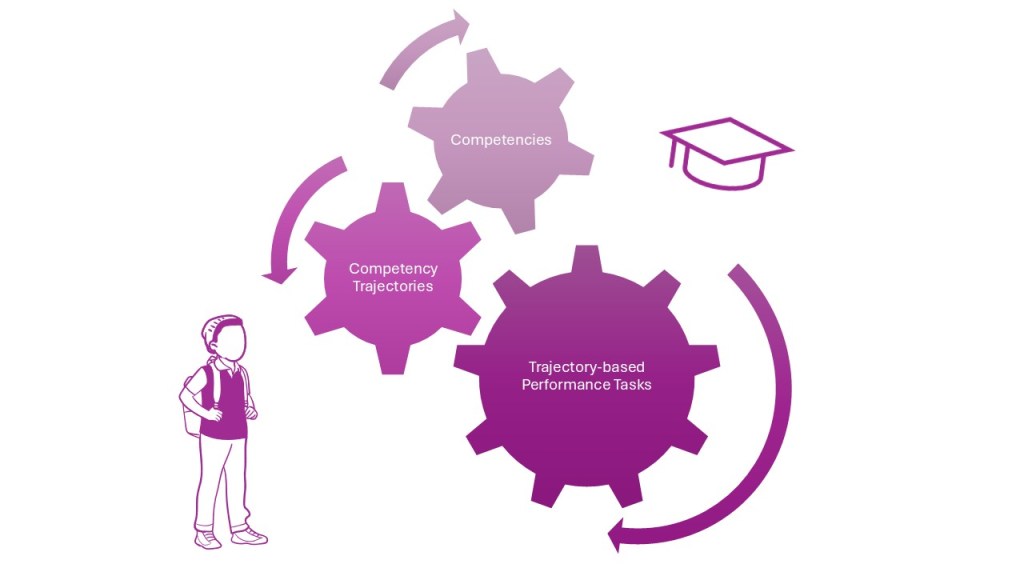
Our education system may not be cultivating the workforce of tomorrow. A recent article in Forbes shows that many managers believe Gen-Z workers lack essential skills like problem-solving, collaboration, creativity, and the ability to engage in productive conflict resolution. As a result, these young graduates are less likely to be hired. Brandt et al. (2025) documented that students need more than traditional schooling to succeed in the future workplace. For these reasons, a growing number of organizations believe competency-based education may be a solution to critical student engagement and work force readiness problems identified within our educational ecosystem.
Competency-based education is designed to organize a school’s structure and learning approach around students, rather than organizing students around the structure of the school. Ideally, each student’s current performance level and individual learning needs drive the alignment of students to teachers, curriculum, and supports—ensuring that every learner develops the skills necessary to be college- and career-ready. Because students’ knowledge and skills evolve at different rates throughout the year—often depending on whether they have had sufficient learning opportunities—the teachers, curriculum, and supports adapt to follow the student’s learning path.
Competencies form the structural framework of competency-based education. When a student demonstrates mastery of the competencies for a course, they advance. Personalized learning is the theory of action. It provides students with customized learning paths that align with competencies and allows them to show mastery of a course competency using an area of personal interest. Students, working with educators, have agency in their learning experiences, ideally building their capacity to become self-directed and self-regulated learners. Blended learning—a combination of online and face-to-face instruction—gives students some control over when, where, and how fast content is delivered. For example, Marzano and Hardy (2022) described “playlists”: a progression of assignments that students access when ready. Blended learning is an essential part of personalized learning. Proficiency in course competencies leads to advancement, personalized learning supports student interest and agency, and blended learning is a component of the “how.”
“Competency-based education is designed to organize a school’s structure and learning approach around students, rather than organizing students around the structure of the school.”
Starting a Transition
Competencies are analogous to well-constructed “big ideas.” They are explicit, measurable, observable, transferable, and enduring. A competency-based system requires teachers to understand all the competencies a student must demonstrate across grade levels so that learners can be matched accurately to instruction and resources that will move them beyond their current performance level. Teachers must deeply understand what proficiency looks like at the exit level for each competency, and districts must develop shared interpretations of high-quality student work across schools. This means that some students may need more time to complete a course or unit than others.
In a competency-based system, assessment should be a “meaningful, positive, and empowering learning experience for students that yields timely, relevant, and actionable evidence” of learning. If students perceive assessments as mere compliance exercises, they may disengage. This undermines the goals of the model. Teachers and students need clear expectations, competency trajectory descriptions, and examples of high-quality work to clarify learning targets. These might include audio recordings of students reading aloud in elementary grades, writing samples at various proficiency levels, or high school research papers and lab reports that reflect authentic student thinking. With clear expectations, formative assessment practices like self-assessment can flourish.
Complex performance tasks offer students multiple opportunities to master, integrate, and demonstrate skills. Ideally, these tasks are authentic, require real-world application, and call for students to transfer and integrate multiple standards that are related to the competency big idea. Students should have chances to revise their work in response to feedback. If a student is not initially successful, later demonstrations of competency can serve as evidence. This requires high-quality performance tasks and calibration protocols that allow teachers to interpret student work and match it to stages in the competency trajectory descriptions. They can share feedback with a student regarding what evidence is present and what evidence of problem solving and thinking are needed next.

Education by NEC Corporation of America CC by 2.0.
In a competency-based system, teachers must be skilled at interpreting authentic student work. When teachers and a student believe a student is ready to exit, standardized measures can confirm or disconfirm collaborative judgments about readiness to advance to the next course or grade. States may provide access to innovative, through-year assessments that support instructional placement decisions in addition to supporting Federal accountability. There is no doubt that stakeholders have to thoughtfully plan how to bridge personalized learning paths with standardized, age-based testing.
As districts adopt learning trajectory approaches to competencies, they may discover that the supports students need go far beyond traditional notions of differentiated instruction. Teachers need clear policy guidance and permission to adapt and collaborate across grade levels. Students should be encouraged to document growth from the start of the year, with student-led conferences showcasing portfolios of authentic work. States can help by aligning digital curricula with standards and ensuring that schools have appropriate resources for differentiated learning. Districts should explore mastery-based learning management systems capable of collecting evidence of student progress over time.
In schools that are further along, Hess et al. (2020) find that teachers more fluidly support students working at different learning stages, while also providing core instruction. These teachers help students monitor their own goals.
Students educate the public about the Constitution by KOMU news CC by 2.0.
Creating a Strategic Plan
Year 1, First Semester: Explore and Learn
Before adopting a competency-based system, staff need deep knowledge of standards alignment and formative practices of interpretation of student work for instructional decision-making. Teachers should be skilled in supporting students with accommodations. The first semester should focus on exploration. Encourage staff to read over the summer and start the year collaborating on a theory of action for the school or district. Virtual meet-and-greets with others in the field engaged in this work can help teams prepare for structural changes. Books like Breaking with Tradition and Leading a Competency-Based Secondary School are valuable tools for building a shared vision and strategic implementation plan.
Year 1, Second Semester: Big Ideas
Develop big ideas that define competencies for a course that consolidate related standards. Begin building a repository of student work exemplars that illustrate authentic, independent demonstrations of desired skills. Creating big ideas (competencies), competency trajectories, and performance tasks are where the forthcoming book Creating Competency-Based Education Assessment Systems to Support College and Career-Ready Students by Schneider and Forte is situated.
Year 2, First Semester: Competency Trajectories
Build trajectories for each competency across the targeted grades and content areas. This foundational step promotes shared understanding of proficiency across the system. Evaluate learning management systems that support trajectory-based student progress and portfolio systems rather than traditional grading systems.
Year 2, Second Semester: Trajectory-aligned Performance Tasks
Use trajectory evidence statements to inform the development of authentic performance tasks. Teacher teams can focus on task creation and explore curriculum resources, including appropriate technologies, to support a cohesive, personalized learning and blended learning environment.
Year 3: The Slow Start
Ask teachers to pilot two competencies. During this time, create a professional development framework focused on student-paced learning, student led conferences, check-ins with teacher mentors who support the student in self-advocacy and accountability, and provide training materials for calibrating expectations of student work. Collect and archive examples of student work along each trajectory.
“If students perceive assessments as mere compliance exercises, they may disengage. This undermines the goals of the model.”
Creating a strategic implementation plan rooted in readiness allows mindsets to evolve and creates a flexible system—tight on achievement expectations, loose on instructional approaches, especially in the early stages. Begin with the first two vision questions recommended by Stack and Vander Els (2017):
- What is our commitment to each child’s learning?
- How will we respond when some students don’t learn?
- What relationship centered on student learning will we establish with parents?
The additional third question shifts the conversation, empowering students to take ownership of their growth and lead their learning report on progress through conferences. It also invites families into meaningful decision-making about soft skills that may be in need of development.
Use lessons learned to scale up. Deeper Competency-Based Learning provides school teams tools for self-assessment to determine which organizational shifts you want to tackle next. To succeed, we must create a continuum of learning anchored in clearly defined competencies and aligned learning targets. Our goal is to graduate engaged, self-directed, motivated, competent learners who grow into our future colleagues, leaders, and citizens.
 Actionable Assessments in the Classroom
Leave a comment